
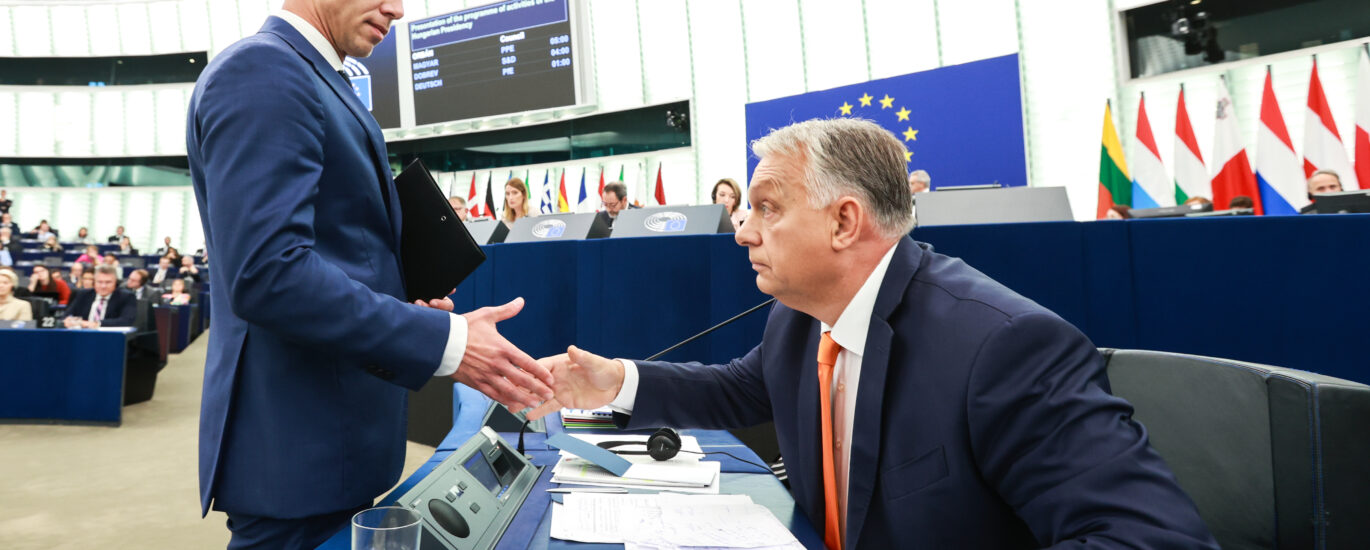
Dr Eitan Tzelgov, University of East Anglia
On Saturday I was anxiously checking my phone to see what was going on in Hungary’s election. I am currently writing a book about populism in Israel, and the parallels between Israel and Hungary have been striking since the current Israeli government announced its plan to politicize the courts in 2023.
At 8 PM, Peter Magyar, the leader of Tisza (Respect and Freedom) Party, a man no one outside of Hungary, including myself, book and all, knew about two months ago, posted on X that Orbán had called to congratulate him on his win.
Trump Before Trump
Orbán? Just like that? I had to double check this was not a fake X account. Orbán is the man who :
- Steve Bannon called the ‘Trump before Trump’?
- The man who, when he lost in 2002, said “The Homeland cannot be in opposition”?
- The man who, in 2002, started a civic movement to challenge the government?
- The man who wanted to “spiritually revive” the Hungarian nation?
- The man that called all those who were not nationalistic or religious “traitors”?
- The man who in 2009 promised that in power his party would eliminate “divisiveness, political conflict, and unnecessary debates”?
- The man who was the defender of Judeo-Christian civilization?
- The man who promised to cleanse the state?
- The man who claimed, after winning a super-majority in 2010, that now Hungary was finally free from “after 46 years of occupation, dictatorship, and two chaotic decades of transition”?
- The man who manipulated the electoral system, packed the courts, seized control over almost the entire media system, established a corrupt crony system, and created a regime he called ‘illiberal democracy’, concedes?
Just like that, Viktor?

This Is Not Hungary!
Not that long ago (though it seems like a lifetime has passed since early 2023) Israelis were rallying to protest the government’s plan to politicize the judiciary. The demonstrations were massive—hundreds of thousands of people arrived every Saturday, well organized, with banners, loud speakers and all. There were clashes with police. One of the recurring slogans captured what seemed clear to Israelis: that Israel was on its way to become Hungary. And so they used to shout, calling out the name of the prime minister and his wife: “Bibi, Sarah, this is not Hungary.” It sounds better in Hebrew.
The protesters weren’t wrong. Six years ago I ran an analysis showing Israeli democracy was following the same trajectory as Hungary’s—measures of democracy were declining in Israel, but not as rapidly as in Hungary. We were a few years behind, watching the road ahead.
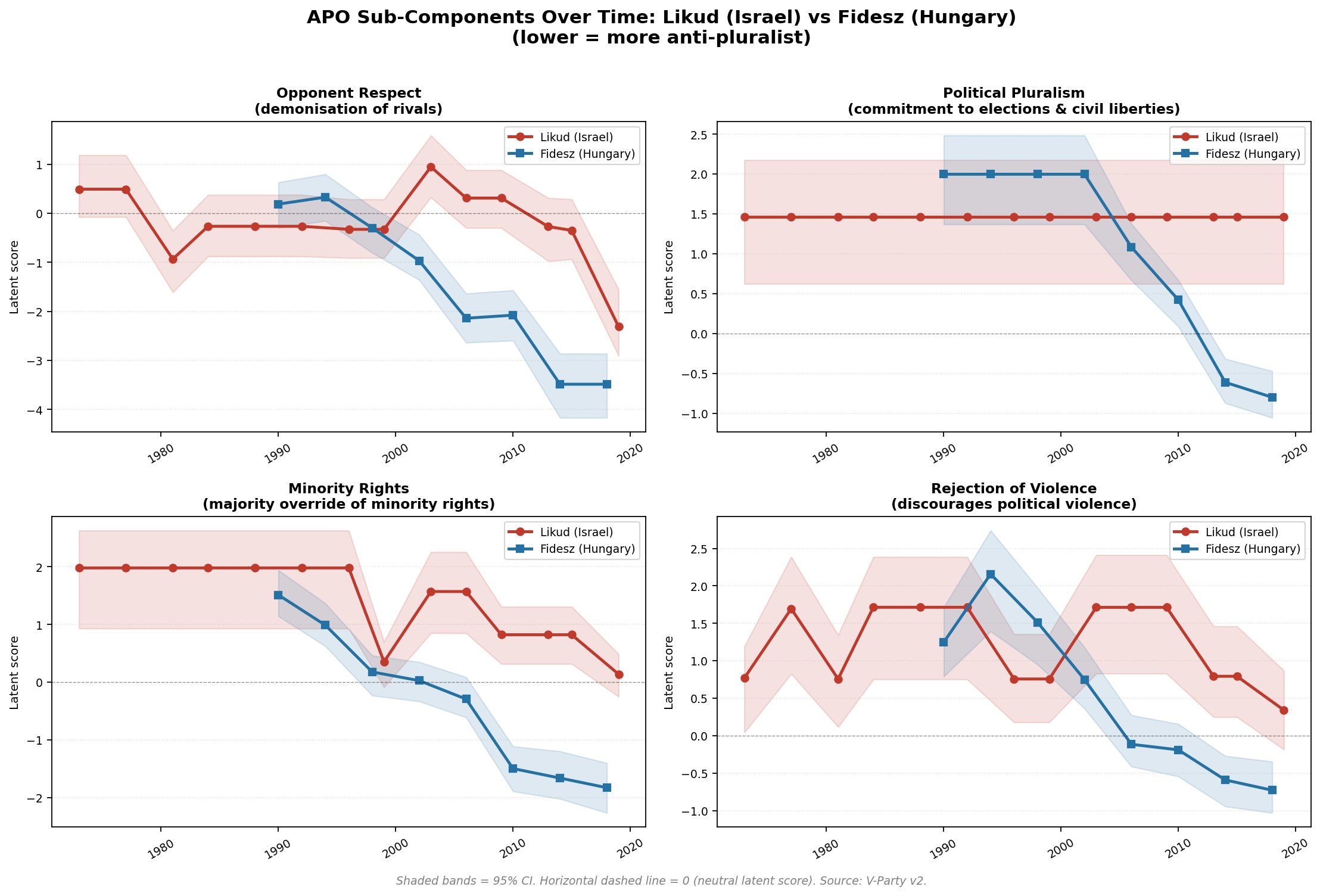
More recently, I have started to look at the similarities between Israel’s former center-right and now fully radicalized ruling party, Likud, and Orbán’s party, Fidesz. Both parties were bad news for democracy: they were, to varying extents, what the Varieties of Democracy researchers call “anti-pluralist” parties—those that reject the view that a democratic society is composed of lots of groups that needed to be heard and constitutionally protected. And, in a cool paper, Staffan I Lindberg and Juraj Medzihorsky showed that such parties were likely to become a real threat to democracy.1
I agreed. So I dug a bit into the Varieties of Democracy data about parties. I plotted the trajectory of the two parties: in the figure below you can clearly see that the two parties have become much more aggressive towards their opponents and towards minorities. You can also see that Fidesz is much worse! Across all indicators, including respect for the electoral process and the basic democratic idea, their values are really low. And the data only goes up to 2019. We have no evidence suggesting that Fidesz has become more pluralist over the last seven years. And yet, they conceded the election.
The Mobster attitude
It doesn’t end there. Orbán looked tired and defeated throughout this campaign, but remember: the guy was a lightning rod for the world’s wannabe populist leaders. Populist movements claim to represent the people; because of that, elections are a really important ritual for them: they enable them to identify the will of the nation, reveal the political ‘truth’, and reaffirm the relationship between the people and their leader.
So, losing an election is an existential crisis for populists. How can a movement that represents the people lose, when we actually ask the people what they want? In other words, for populists in power, elections are not a referendum on a specific policy. No. Elections are a referendum on the legitimacy of the system: by playing the electoral game, populists in power give the democratic system “an offer it can’t refuse.” If elections produce the correct result, they keep playing—though possibly with a more tilted playing field in the future. If they fail to do so, the system is rigged and must be challenged.
We saw this happening time and again: in the U.S., in Brazil, populist leaders, their movement, and their supporters are shocked when they lose (the shock is both real and manufactured) and storm, very literally, democracy. When Likud lost the 2021 election in Israel, its supporters did not storm parliament, but there was no concession, no orderly transfer of power, and I urge you to try and watch the swearing-in ceremony of the so-called ‘Change’ coalition the replaced Likud. For those of you who don’t have the spare time to watch 8 hours in Hebrew, I’ll make it simple: it wasn’t very nice and you’ll find better manners in the East Anglia Derby.

We did have a taste of that in the run-up to the election. Orbán’s campaign was using AI to spread disinformation about the regime’s opponents, spreading stories about the Ukraine and the EU trying to drag Hungary to war, and claiming there was a plot to blow up a crucial gas pipeline—all of these are veiled threats: play your cards carefully, opposition, media, we still have the power to blow this up. Even J.D. Vance found the time to take a break from his war, to visit Budapest, and threaten everyone on the continent in an attempt to help his buddy Orbán.
Political scientist Adam Przeworski elegantly described democracy as: “a system in which parties lose elections.”2 The initial populist reaction to losing can take many forms: refusing to participate in the transition of power, legal contestations, adopting a more aggressive rhetoric towards the system, or outright violence. Regardless of the initial reaction, the underlying theme when populists move to the opposition is that the will of the people was stolen and the system is illegitimate.
And, so far, none of that happened.
Why This Time Was Different
Back to Israel. In early 2023, Simcha Rothman, a member of the right-wing populist Religious Zionism party and one of the lawmakers leading the current coalition’s assault on the judiciary— following the Hungarian protocol—appeared on a liberal investigative journalism TV show. When asked about the feelings of those demonstrating against the government’s policy, he stated: “You ask if I dismiss their fears? Yes, I dismiss their fears.”

Orbán’s loss is a setback for the right-wing radical populist global movement, as well as to Netanyahu and his government, who are expected to face an election this year. But if you were to listen to Israeli pundits who support the government, you would have thought they won. This was their vindication: those fear mongers, those who claimed that democracy is under threat and have warned that Israel is walking down the Hungarian path are a bunch of hypocrites. Orbán conceded. This means he is a democrat at heart—and so is the Israeli government—so stop with your usual liberal moral panic already.
Does it all really come down to the definition of democracy? No.
In 2017, Norwegian political scientists Carl Henrik Knutsen, Håvard Mokleiv Nygård, and Tore Wig published research showing that autocrats, such as Orbán, use elections to reaffirm their domination over the opposition. But here’s the problem: during election years, the chances of their regime collapsing are five times higher than in the years that follow.3
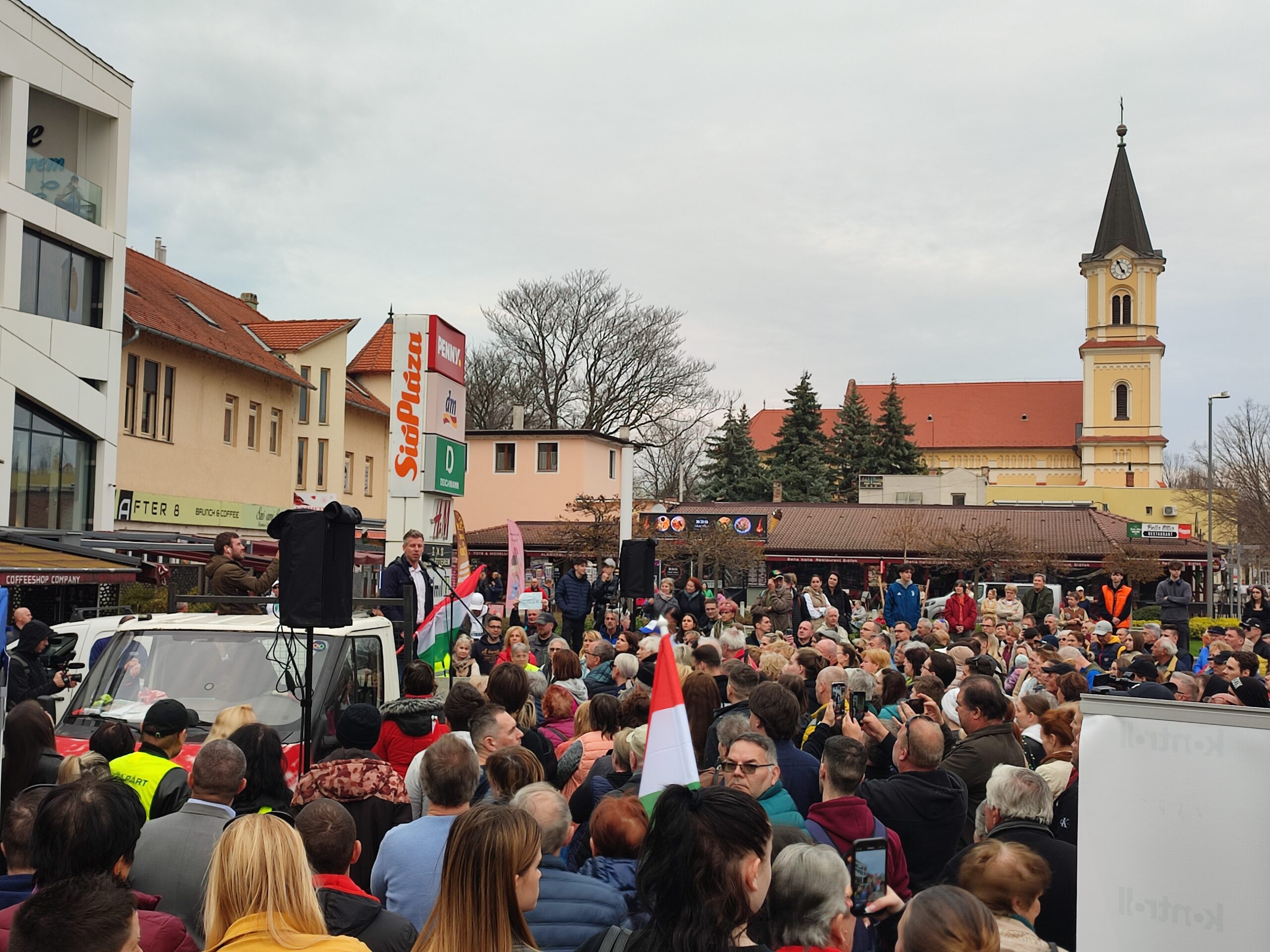
Why? Because elections are focal points. Opposition actors who can’t always coordinate have one event, one opportunity to rally around. Citizens begin to mobilize. And if there is a feeling that victory is finally achievable, you get a snowball effect. More people show up, signalling to others it’s safe to participate, which brings even more people. Have you seen the size and energy of Magyar’s rallies?
The truth is that there is nothing certain about the way populist politicians run the state. It’s not a closed autocracy like, say, North Korea. Even Orbán, clearly a man with a plan, who really did pave the path for other populist leaders, did not have full control of the state. In the last Varieties of Democracy report, Hungary was classified as an ‘electoral democracy’: where elections very much rigged in favour of the rulers. But there is still a chance.
And the chances grew when opposition forces saw the opportunity and let Peter Magyar lead. This coordination was crucial for the landslide, and it was remarkable in magnitude: the liberal Momentum, the Democratic Coalition, even the socialist (post-communist) MSZP parties all bowed out of the competition when they sensed that victory was at hand.
This is a massive win. Obtaining more than two-thirds of parliamentary seats will enable Magyar’s new government to change the constitution and begin the uphill battle of ‘post-populism’: fighting state capture in the media, civil service, the economy, the judiciary… The task will be truly Sisyphean, because populism—its political, economic, and ideological infrastructure—does not just disappear once it loses. Just ask the Americans.
Landslides, Fatigue, Observers, and Money: Why A Coup Didn’t Happen in Hungary
But the landslide helps, of course, explain the gracious phone call conceding defeat. As horrendous data from Orbán-leaning urban constituencies started flowing to the HQ of the populist leader, it became clear that the game was up. Remember Trump’s election denialism in 2020? As a Republican state delegate from Virginia said, “For me to be convinced that Biden has won, I would have to know that he was ahead on election night.”4 The size of the margin matters: big leads squash even ardent election denialists.
Did I say Orbán looked tired? It wasn’t just physical fatigue. Anne Applebaum observed recently: “Orbán has run out of enemies. He’s used migrants. He used the threat of LGBT gender changes. That’s really not working anymore.”5 This is a crucial insight. It points to a possible limit on the power of populist ideas: us-vs-them, hyper-polarization, constant crisis mobilization. There were enough Hungarians who had simply had enough of this cycle to break away from it.
It also turns out that international institutions matter. The Organization for Security and Co-operation in Europe (OSCE) had sent hundreds of election observers from dozens of countries. And, with the United States doing its best to wreck international organizations, NATO, and the EU, one more thing has to be said: this, at least in the short term, is a significant win for the European Union. In the new cold war between the EU and the Russian-MAGA coalition, the EU, while stopping short of endorsing Magyar, was able to put economic pressure on the Hungarian regime by withholding funds. Yes, the EU moves very slowly, but given the election results, international pressure and monitoring, a Trump-style coup attempt might have been a little too much for Orbán.
Orbán is the author of the 21st century populist playbook. But his opposition just wrote a different book: unite behind a credible challenger, mobilize for a landslide, and let international institutions do their work. Even the architect of illiberal democracy can lose—if you give him no other choice.
- Juraj Medzihorsky and Staffan I. Lindberg, “Walking the Talk: How to Identify Anti-Pluralist Parties,” Party Politics 30, no. 3 (2024): 420-434. ↩︎
- Adam Przeworski, Democracy and the Market: Political and Economic Reforms in Eastern Europe and Latin America (New York: Cambridge University Press, 1991), 10. ↩︎
- Carl Henrik Knutsen, Håvard Mokleiv Nygård, and Tore Wig, “Autocratic Elections: Stabilizing Tool or Force for Change?” World Politics 69, no. 1 (January 2017): 98-143 ↩︎
- Catherine Kim, “What Trump’s Diehard Supporters Are Worried About This Election,” Politico, September 30, 2020, https://www.politico.com/news/magazine/2020/09/30/trump-delegates-election-focus-group-423015. ↩︎
- Anne Applebaum, quoted in tweet by @BlueGeorgia, X (formerly Twitter), April 12, 2026,
↩︎